
Sandy Verma
Tezzbuzz|01-10-2026
South African cricket is currently living through a paradox. The sport has never been so popular or saturated as it is now, with overseas and women's fixtures, a huge SA20 and domestic competitions cramming in a record 78 match days in a season. But the country's iconic pitches are wearing down under the strain.
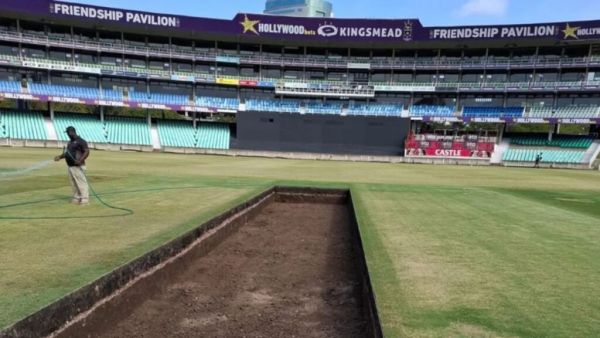
In the past, this meant old, slow, uneven tracks. Relaying a whole square is time-consuming and leaves a ground without a pitch for several months. Twenty years ago, when Australia had to share its sports grounds with other sports, they developed a system of removable pitches. These were put in at the beginning of summer and removed again at the end, to make way for football. Cricket South Africa's Exchangeable Pitch System aims to solve a similar problem.
A system of removable cricket pitches will allow South Africa to host multiple matches in the same stadium in the same season without losing the unique characteristics of its iconic grounds.
More Than Just a Drop-In for South Africa
The difference between Australia's famous drop-in model and South Africa's EPS lies in the motive and application. Drop-in pitches are constructed to alternate between different sports within multi-purpose stadiums, whereas EPS is all about rotating surfaces in the cricket season itself.
By swapping pitches in and out as needed, groundsmen are able to effectively double venues' capacity for world-class cricket, reducing the level of wear and tear without having their grounds closed for lengthy periods.
“We haven't really installed new pitches for many years, because we can't,” Hilbert Smit, Cricket South Africa's long-time pitch consultant, explains. “We can't just take one of the pitches out for a season because that will reduce capacity… so we are introducing an exchangeable pitch system, and we don't want to call it drop-ins because that's not what it is.”
In order to maintain their characteristic carry and bounce, EPS does not use foreign or uniform materials.
Every venue that has signed up for EPS uses their home trusty Bulli soil in conjunction with locally-preferred varieties of Cynodon grasses.
Grown up in steel trays on the outfield, not the main square, these pitches are able to be controlled at a microscopic level of fertility and moisture from the outside in.
The Life Cycle of an EPS Pitch
From initial planting to a match-ready surface, the entire process takes 18 months.
Once laid on the square, it takes 5 to 6 days' worth of settling time before play can begin.
A tray can host the normal high-level cricket schedule of 5 to 8 days before being swapped out for a new set.
Six major SA20-hosting grounds have signed on the dotted line for EPS: the Wanderers, Kingsmead, Newlands, St George's Park, Boland Park and SuperSport Park.
Wanderers: The leaders of the pack, who have planted their first seeds in 2024 and are currently the only venue to have hosted a professional match using the system. They may even get a chance to use their exchangeable track for the upcoming 2027 ODI World Cup.
Newlands: set to follow the Wanderers, potentially featuring an EPS game before Christmas, although some minor tweaks, like the positioning of cameras, are still up to working out due to the tray's placement.
Domestic Test matches: St George's Park, Boland Park and Kingsmead will be introducing the system via their domestic matches this season, and SuperSport Park will be putting it off until after the 2027 World Cup before diving into it.
Curators are being pragmatic and avoiding Test matches on their exchangeable surfaces for now, using their domestic fixtures as the ultimate test case.
The value of a smart pitch is difficult to overstate, especially after the rushed pitches at the T20 World Cup in New York.
But by taking control over their own schedule and avoiding the risk of short-circuiting a strict timeline, South Africa's Exchangeable Pitch System looks set to be a masterclass in modern ground management. If the upcoming World Cup trials are successful, this homegrown solution could well become the new standard for cricket nations grappling with a tightly packed modern calendar.



Madhya Pradesh Ranji Trophy 2026-27 squad: Shubham Sharma to lead

Pragyan Ojha named interim chairman of selector after Agarkar exit

Zak Crawley returns to Perth Scorchers as Finn Allen replacement for BBL|16

Kuldeep Yadav Chases ODI History! Just Two Wickets Away From Joining Elite Club