
Samira Vishwas
Tezzbuzz|04-10-2026
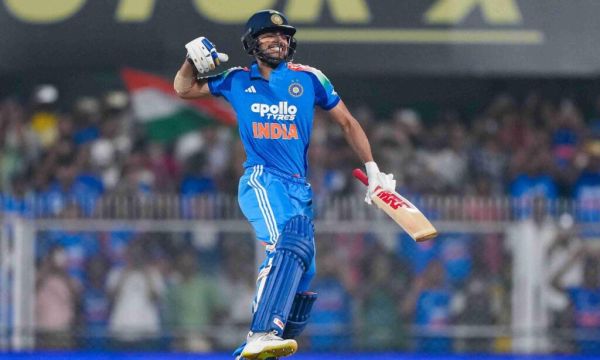
The numbers from the Guwahati ODI were extraordinary, but also slightly uncomfortable. West Indies scored 405 for seven. India chased 406 with 39 balls still left. There were five centuries across the two innings and 811 runs in total. Shubman Gill made 223 not out. Rohit Sharma scored 101. John Campbell, Shai Hope and Amir Jangoo had already put three centuries on the board for West Indies.
It was a remarkable display of batting. Unfortunately, it was also the kind of game that raises a larger question about where ODI cricket is heading. Gautam Gambhir raised that question himself after India’s record chase. The India head coach said there needed to be more of a contest between bat and ball. His concern was straightforward: If conditions leave bowlers with little influence, the balance of the game starts to change.
ICC’s concern
The timing of the discussion is significant since ICC CEO Sanjog Gupta has spent much of this year talking about how international cricket needs to give fans more reason to care about individual series.
Also read: Record-making Gill, Rohit power India’s 8-wicket victory in 2nd ODI, seal series 2-0 vs WI
In August, he said the era of “randomly scheduled bilateral series” had to end, arguing that cricket needs context, culture, competition and competitiveness if it is to remain sustainable. He also said ODI cricket still has a place in the international game, with its future closely linked to the men’s and women’s World Cups.
ODI format’s identity
If ODI cricket is trying to retain its place between Test cricket and T20s, it has to preserve the quality of the contest that makes the format worth watching. That responsibility can’t sit only with the players. It also sits with the people who decide where international cricket is played and the conditions in which it is played.
There is nothing inherently wrong with a 400-run ODI. Modern batting has changed, and watching a team attack from the beginning can be one of the attractions of the format. Shubman Gill’s 223 in Guwahati was an extraordinary innings and should be remembered that way. The concern begins when the pitch leaves the bowling side with very few ways of changing the game.
Bowling challenge
A 400-run total can come from exceptional batting. But on a surface where bowlers have little margin for error and little help from the conditions, questions arise. In Guwahati, West Indies made 405 for seven. India then reached the target in 43.3 overs, losing only two wickets. The two teams produced 811 runs and only nine wickets across the match. That is an extraordinary statistic. It is also worth asking what it says about a format that already has plenty of competition for space and attention.
Also read: As ODI series finale heads to Lord’s, all eyes turn to Rohit Sharma’s future
Test cricket has its own identity built around patience and the possibility of a match developing over several days. Simultaneously, T20 cricket has created an entirely different space around speed, power and short bursts of skill. ODI cricket has traditionally occupied the space between the two.
Middle ground
That middle ground gave it much of its appeal. Fifty overs allowed teams time to build an innings, recover from setbacks, create pressure and then accelerate. Bowlers had different phases to work with. Captains had time to change plans. A match could move in several directions before reaching its conclusion.
The format already faces a crowded international calendar, the growth of franchise T20 cricket and questions over the relevance of bilateral series outside the World Cup cycle. Gupta’s comments recognise part of that problem. His argument is that ODIs need context and competitiveness, and that the World Cup remains central to their place in international cricket.
Role of BCCI
Gupta has made clear that bilateral cricket is largely the responsibility of the member boards, while the ICC is responsible for its global events such as the World Cups and World Test Championship. In that sense, the BCCI is responsible for the conditions under which India’s bilateral home cricket is played. It has the resources and influence to make those matches an important part of the future of ODI cricket.
Also read: India retain top spot in men’s ODI ranking but with narrowed lead over New Zealand
That does not mean every Indian ODI needs to become a low-scoring game. It does not mean preparing green pitches or taking batting out of the equation. It simply means giving the bowlers enough to work with. There is a difference between a pitch that rewards good batting and a pitch where the only meaningful question is how quickly the batting side can score. The first produces a contest between skills and the second risks turning the match into a race between batting line-ups.
India’s influence
This is the balance that the BCCI can influence. Moreover, India’s importance in world cricket also means the conversation does not stop at Indian shores. What happens in India is watched closely because the country’s cricket ecosystem has an influence far beyond its own bilateral calendar. If India can produce ODIs where 300-plus scores remain possible, batters can play aggressively and bowlers still have genuine opportunities to change the game, it would provide a useful example of what competitive modern ODI cricket can look like.
And the timing could hardly be more relevant. The ICC has just announced the schedule for the 2027 World Cup, which begins on October 2 next year in South Africa, Zimbabwe and Namibia. India will begin its campaign against Australia in Cape Town on October 7. India’s bilateral ODIs are part of preparing for a World Cup played in different conditions. The preparation should therefore involve more than finding the right batting combinations. Bowlers need to be tested. Batters need to adapt to different conditions. Captains need tactical problems to solve. Teams need to experience matches where momentum can change because of something other than a batting collapse.
A wider question
The Guwahati match can also be the starting point for a more useful conversation. What should an ODI give an audience that they cannot get from a T20? The format needs its own rhythm and its own contest. It needs enough time for a game to develop and enough uncertainty for a team that is behind to believe it can still change the result.
With the 2027 World Cup now just a year away, the BCCI has a timely opportunity to show the rest of the world what the next version of ODI cricket can look like.



India vs West Indies: Super Gill takes centre stage as India eye clean sweep

Ajinkya Rahane picks the next ‘Fab Four’ in international cricket

Asian Games 2026: Ankush Panghal and Sujit Kalkal won gold, Lovlina-Parveen also champions in boxing
15 fours, 13 sixes, 188 runs… Luan-Dre Pretorius wreaked havoc, Gayle's world record broken