
Sandy Verma
Tezzbuzz|13-10-2026
The Indian cricket team's recent performances against the West Indies have been a source of concern for many. The team's bowlers have struggled to produce breakthroughs and contain the opposition's scoring line, especially with Jasprit Bumrah sidelined. However, what many fail to understand is that the young guns may be unfairly judged on performances due to the rising trend of high-scoring T20 cricket matches.
While it is true that the bowlers have failed to produce at critical moments and concede too many runs per over, a bowler's economy rate may not reflect his true value if the pitches are batting-friendly and the conditions are conducive to high-scoring encounters.
The rise of entertainment-driven T20 cricket has seen a shift in the sport's culture. The fans now want to see fireworks, and the matches' organizers will do everything to give the spectators what they want to see. As a result, the conditions may be unfairly stacked in favor of hitters, and the changes in conditions and laws may make the contest between bat and ball more unbalanced than ever.
Are batting-friendly conditions making life difficult for Indian bowlers?
It would be unfair to say that bowlers are to blame for the lofty scores witnessed in the modern T20 era. Flat, smaller boundaries and dew can rob them of the margin for error they require to curb aggressive batters even when the former are executing their plans reasonably well.
However, one cannot simply attribute expensive spells solely to the conditions either. Poor lines, lengths and variations deserve criticism regardless of the surface and results.
It seems a mix of both factors has played a role in India's struggles with Indian conditions.
The absence of Bumrah has also forced their other bowlers to show greater consistency under pressure. Youthful pacemen have the skill to trouble international batters, but it is one matter to show that ability, and another to turn it into economical spells and match-winning performances.
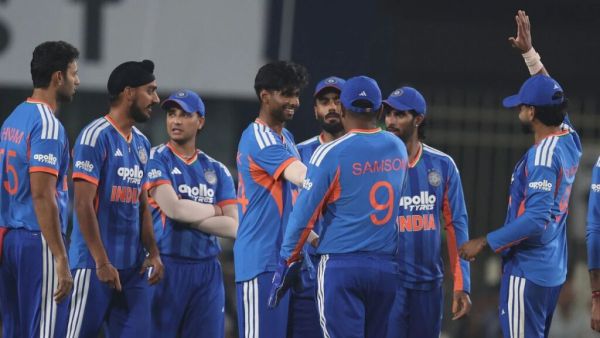
Mayank Yadav's spell in the second T20I against the West Indies in Ranchi last year was an interesting case in point.
Mayank Yadav's three-wicket spell highlights T20 bowling dilemma
The left-arm pacer showed the devastating effect his raw pace can have on international batters, picking up two wickets in his first over before ending with a total of three dismissals in the match. His most spectacular delivery came in the form of a lightning-fast 149.5 kmph that sent Rovman Powell back to the pavilion.
On paper, it looked like a fantastic performance by the young fast bowler. In reality, he leaked 36 runs in his three overs and failed to complete his spell as the West Indies chased down India's 250 in 18.3 overs for the highest successful run chase in men's T20I history.
The figures highlight the problems with judging bowlers on the basis of high-scoring T20 games. Yadav's ability to bowl his absolute fastest and pick up key wickets is unquestionable, but so are the contributions of the runs.
An expensive economy rate does not always translate to a negative all-around performance while taking wickets cannot atone for a lack of control.
One must examine all the evidence objectively. That is, how a bowler has been affected by the conditions, the quality of the opposition and the timing of the wickets.
In Mayank's case, the challenge is to build upon the wicket-taking ability to develop the control to curb the scoring rate when the batsmen are determined to go after the bowler.
Gautam Gambhir calls for a fair contest between bat and ball
India head coach Gautam Gambhir has also spoken against the fact that bowlers today have it harder due to the conditions. In the wake of the West Indies chase, Gambhir reminded the cricketing public that bowlers deserve a chance and protection in a game that has tilted towards aggressive batters.
“They aren't foreign bowlers; their careers are also at stake. They also worked hard to sit in this dressing room; it's not like they didn't work hard. They have also worked hard. So if there is an even competition, it will be good, and better cricket will be seen,” Gambhir said.
In essence, he touched upon a larger issue of the contest between the bat and ball. With pitches offering little help to the bowlers and the dew making it difficult to grip the ball, even the best deliveries can be deposited beyond the boundary. Such conditions can be especially difficult to deal with for young bowlers who have yet to find their feet at the international level.
That said, Gambhir's point was not that Indian bowlers should be absolved of all blame. He simply acknowledged a bigger problem of balance in the game and the need for bowlers to find solutions to overcome it.
“We are a world-champion team, so we want to keep improving. And obviously, these are tough conditions to bowl in; we know that. On flat wickets, with the dew, it is tough, but we need to figure out a way to try and stop the opposition, especially when they lost two wickets in the first over, and three in the first six,” he added.
What Gambhir's comments highlight is the difference between holding the cricketing authority accountable versus asking for an easy ride. India may have reasons to complain about the imbalance in the game, but it cannot deny that its bowlers must develop new methods to deal with such conditions.
What must Indian bowlers do to improve in T20 cricket?
While authorities may not be inclined to change the conditions, the focus should be on bowling attacks finding ways to combat it. Varying pace, using yorkers intelligently, mixing up the lengths and planning smartly at the death are all areas in which Indian bowlers need to improve.
In particular, understanding batters and their comfort zones as well as adapting a new plan if the first one does not work are skills that will make or break a bowler's career at this level.
That much should be a given for older campaigners, but it is a challenge that young bowlers like Mayank Yadav must learn to deal with as they progress in their careers.
India's concerns regarding its bowling attack, therefore, cannot be laid entirely at the feet of Bumrah's absence or even the conditions. It is undeniable that the latter plays a role in the former's struggles. With that said, inconsistent performances remain a concern that needs addressing.
In the end, the aim must be to establish a fair contest between the bat and the ball. That is not to say that bowlers should receive special consideration. However, as Gambhir noted, a team must hold itself accountable and find a solution rather than simply bemoaning the circumstances. India's young bowlers have the ability to trouble the opposition, but it is now up to them to use it.






Nathan Lyon ‘extremely grateful’ for record-setting Steve Smith’s slips catching

3rd T20I: Abhishek, Arshdeep power India to 14-run win over WI

Hasan Mahmood's historic feat, became the first Bangladeshi bowler to take a hat-trick in Test.

Lockie Ferguson eyes thrilling T20 showdown with Vaibhav Sooryavanshi