There is a simplicity to Smriti Mandhana. She burst onto the cricketing scene as a shy, goofy, bespectacled girl who didn’t take the world any more seriously than she ought to, who knew how to laugh at herself and, perhaps most importantly, how to get back on her feet after a fall and keep moving. Leadership opportunities over the years, first as India’s vice-captain and then as skipper of Women’s Premier League franchise Royal Challengers Bengaluru, have added layers of varnish to a spectacular cricketing phenomenon, turning her into a product the world can only marvel at.
Murmurs of a baton pass in the national team have been swirling since Harmanpreet Kaur famously hoisted the ODI World Cup trophy for her side and the generations of women who came before her. Whispers then gave way to bold statements of intent, from Smriti herself, after India shambolically crashed out of the T20 World Cup in the group stage yet again.
On podcasts, in interviews and in BCCI’s own match vlogs, the stylish left-hander went from awkward to accountable. She spoke candidly about how wins against weaker nations cannot cushion the side and how the pursuit must be focused on conquering stronger opponents. The giggles were still there, but snuck between pragmatism and planning.
The Lord’s Test win and the two Asian triumphs thereafter nursed the sting of that premature World Cup exit but did little to pull India out of the ‘good but not great’ bracket it finds itself in.
Harmanpreet had taught this side to believe it was capable of victory. Whoever followed her had to help the nation believe it was capable of consistent triumphs. Smriti has since identified that problem statement as the one she wants her captaincy to be defined by.
There was no press conference to announce her takeover. The news came in a late press note from the Board of Control for Cricket in India (BCCI), hardly a surprise given that images from a selection meeting for the Zimbabwe white-ball series had earlier been shared by BCCI, with Smriti the lone player part of the think tank.
“It’s a job which you can never feel that you know everything about,” the new skipper said. A few days later, Smriti, who had previously led India in 18 T20Is and four ODIs, sealed her first series win as full-time captain in India’s historic first-ever bilateral engagement against Zimbabwe.
Down to business : Smriti’s unbeaten 47 against Zimbabwe in the second T20I of the ongoing series, with able support from opening partner and deputy Shafali Verma (right), is the kind of contribution she will want to make on autopilot as she seeks to build a broader team culture.
| Photo Credit:
BCCI
Smriti frequently speaks about how individualistic her approach to the game has traditionally been. It is understandable for an opening batter who, on most occasions, needs to shut the world out and focus primarily on herself.
That blinkered approach has taken her to the zenith. Smriti is the leading run-scorer in T20Is across both men’s and women’s cricket and has overtaken Mithali Raj as the leading scorer across all three formats in women’s internationals. She is also the first woman to breach the 11,000-run mark in women’s cricket. These are just a few of many impressive data points.
Leadership, however, exacts a toll. You think for 15, not just one, and the one — yourself — can fall by the wayside in the process. Harmanpreet’s fluctuating returns with the bat are a warning enough for Smriti, who brings immense value to the team at the top of the order. With the middle-order stutters now an established problem for this Indian side, Smriti the opener cannot afford to wane. Her stellar unbeaten 47 against Zimbabwe — a ‘weak’ opponent — is the kind of contribution she will want to make on autopilot as she seeks to build a broader team culture.
For that, she needs her players to be independent thinkers.
“The first thing we need is for 15 people on the side to be leaders. They should feel like they’re the leader of their own skill and what they need to do. I want a culture where they can make decisions for themselves. I am here to support them, but they need to stand on their own; only then can we go ahead as a team,” she said.
Batting order contributions to India’s T20I totals from 2024 to present (before Zimbabwe’s tour of India)
Openers (No. 1-2)
47.03 percent — 2,663/5,662 (higher than AUS, ENG and SA)
Middle order (No. 4-7)
33.9 percent — 1,924/5,662 (lowest among AUS, ENG and SA)
Balancing success and unity
That proposition is easier said than done. Smriti has learnt the ropes of leadership in front of cameras — TV, mobile phones and everything in between. Her evolution into one of the game’s best has happened in the social media era, where every small action, or even the absence of one, is dissected down to its smallest detail.
Smriti’s ascent to captaincy played out under this very lens. Indian cricket witnessed an encore of the fan toxicity that had characterised the rivalry between Virat Kohli and Rohit Sharma’s supporters as she stepped into Harmanpreet’s shoes. Every match vlog posted by the team is accompanied by attempts to decipher Smriti and Harman’s body language, speculate on whether they remain cordial, and debate how Smriti differs from Harman.
It doesn’t help that captaincy transitions in Indian cricket are more often than not Trumpian: barely smooth, if at all. Smriti had a front-row seat when Mithali’s ouster as skipper left a bitter aftertaste across the ecosystem, to the point that it overshadowed even the current transfer of power.
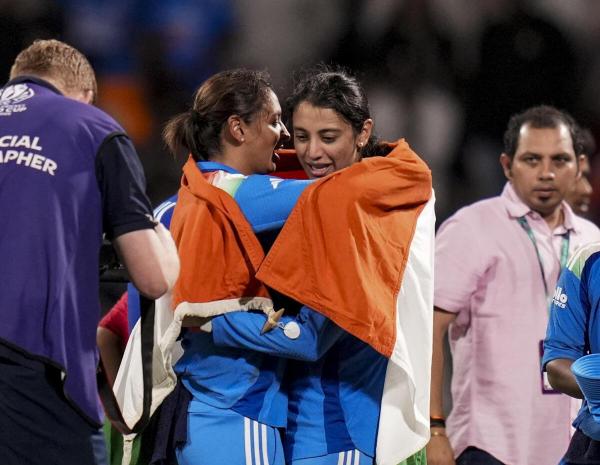
Indian cricket witnessed an encore of the fan toxicity that had characterised the rivalry between Virat Kohli and Rohit Sharma’s supporters as she stepped into Harmanpreet’s shoes.
| Photo Credit:
PTI
Indian cricket witnessed an encore of the fan toxicity that had characterised the rivalry between Virat Kohli and Rohit Sharma’s supporters as she stepped into Harmanpreet’s shoes.
| Photo Credit:
PTI
Harman and Smriti now have a chance to break this metaphorical wheel. There is plenty to remember: being crusaders for Indian cricket in franchise set-ups abroad, serving as each other’s confidants during the home World Cup campaign, which needed their combined grit to pull the side to victory after a string of title-threatening losses, and being the faces of a franchise league they have individually and collectively advocated endlessly for.
“Smriti and I have spent our peak years in this journey together. From training together and being at the NCA, to eating together and even playing video games, we have seen it all. Most importantly, we have always had a strong understanding of each other, and I believe that will benefit us even more now. I will be very happy to support her and stand alongside her as she performs her role as captain. We have built this team together over the years, so I am sure that the energy, trust and understanding between us will remain the same going forward,” Harmanpreet said after stepping down as skipper.
The new captain, who once shared a Player of the Match award with Harmanpreet during the 2022 Women’s ODI World Cup, wants the learning to continue from one of the legends of the game.
“She is the longest-serving captain for India and has been a great leader. The way she works towards a game is going to be inspiring for a lot of people. I hope they watch the way she goes about her preparation. It is important to have her around the youngsters so that they can also be groomed in a way where we could sometimes save a couple of years too,” Smriti said.
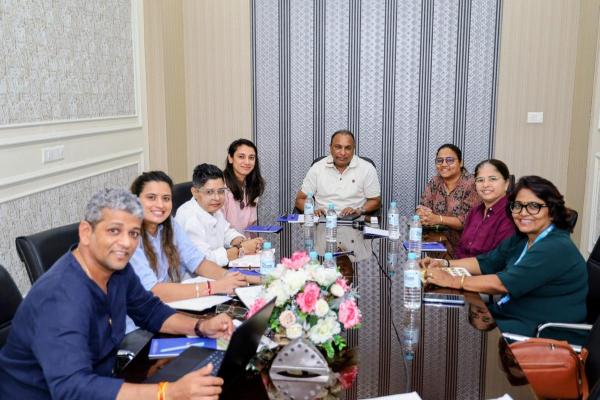
Subtle transition: The news of Smriti’s takeover came in a late press note from the BCCI, which had earlier shared images from a selection meeting for the Zimbabwe tour, with Smriti the lone player part of the think tank.
| Photo Credit:
BCCI
Subtle transition: The news of Smriti’s takeover came in a late press note from the BCCI, which had earlier shared images from a selection meeting for the Zimbabwe tour, with Smriti the lone player part of the think tank.
| Photo Credit:
BCCI
Another WPL success story
Smriti and Harmanpreet have led RCB and Mumbai Indians to two titles each in the Women’s Premier League, keeping the honours with Indian captains — a small win the pair has been immensely proud of.
The Smriti of season one is not the one we see today. The inaugural edition found her well out of her depth, with RCB finishing second-last. She eventually leaned on the experience of coach Luke Williams (who has since moved to MI) and decorated Australian Ellyse Perry in her corner.
“WPL has been very important in understanding how I should set up a team, how we plan for the auctions, what kind of players we want, what kind of brand of cricket we want to play for the next season…,” Smriti explained.
“The WPL has definitely taught me that there should be a vision board. How you then stick around that vision and make players feel they can win any match on their own is the job,” she added.
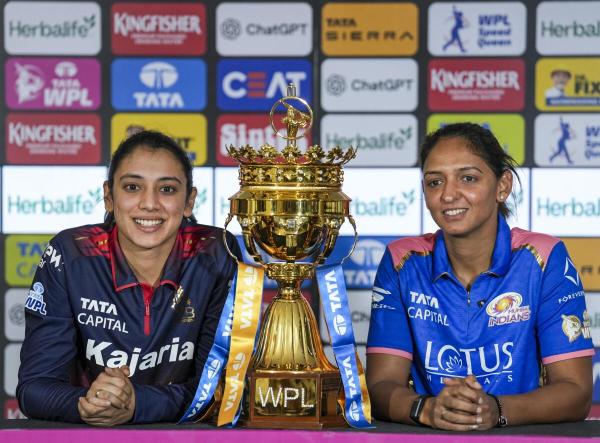
Smriti and Harmanpreet have led RCB and Mumbai Indians to two titles each in the Women’s Premier League, keeping the honours with Indian captains — a small win the pair has been immensely proud of.
| Photo Credit:
PTI
Smriti and Harmanpreet have led RCB and Mumbai Indians to two titles each in the Women’s Premier League, keeping the honours with Indian captains — a small win the pair has been immensely proud of.
| Photo Credit:
PTI
Her first triumph, in 2024, came against Meg Lanning’s Delhi Capitals. The legendary captain is a master motivator, known for placing faith in her players and watching them come good in clutch situations. Smriti beat Lanning at her own game to lift the coveted trophy but, more importantly, established herself as a source of support for a number of Indian players in the side, each of whom stepped up to contribute to RCB’s triumph.
“One thing I’ve learnt is to believe in myself. I thought that’s something that I lacked,” Smriti admitted then.
The composure that comes with it is how Smriti wants her reign as skipper to be about, incidentally a departure from the adrenaline-fuelled intensity Harmanpreet brought to the role.
“I am a little calm one. I want to be a player’s captain and have a lot of calmness in my approach, but if needed, I won’t hesitate to tell my players how to get better in my own way,” she quipped.
One step at a time
In a country where cricket is a religion, leaders inevitably become gods, but not infallible ones. The brickbats come thick and fast, and even the biggest achievements fail to shield the person in question.
“Long-term goals are very far-fetched. If you keep thinking about long-term goals, you do not do the job at hand. You start playing cricket to leave it at a better place. The long-term goal is to win World Cups, to win major championships, and to be number one in all formats,” she declared.
That pursuit will start with the inaugural Women’s Champions Trophy in India early next year.
But, more granularly, Smriti has an unsteady middle order to work on, persistently ordinary fielding standards to revitalise and a young bowling pool to mould into credible match-winners, with the help of senior players such as Harmanpreet and her ODI vice-captain Deepti Sharma.
The last three years under Harmanpreet and coach Amol Muzumdar have also seen a barrage of debuts and constant experiments with the playing XI to address match-specific requirements and weaknesses. Smriti’s style is different; she prefers allowing players time and backing them. Both approaches have their merits and demerits. Finding the right balance will be key.
For a decade, she walked one step behind, carrying the bat, the weight and the silence. Now the road bends towards her. There will be cameras, verdicts and a thousand strangers reading her body language like scripture.
But Smriti has always found her calm at the centre of the storm. If she can teach her squad to lead themselves, then the 10 per cent will no longer be a distance. It will be a doorway, and she will be the one holding it open.