
Sandy Verma
Tezzbuzz|27-10-2026
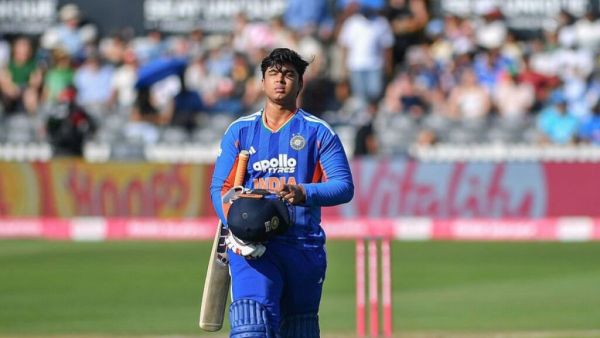
The playing time of India's teenage batting sensation Vaibhav Sooryavanshi has become a hot topic of debate in the country after seeing the youngster sit on the bench during the recent home fixtures against the West Indies. But he finally got his chance on New Zealand soil after Ishan Kishan suffered an injury.
However, the latest team news for the 2nd T20I saw the teenager not open the innings with Abhishek Sharma as expected. Instead, he was kept back and brought in as the third batter.
Sooryavanshi received a hostile introduction to international cricket in New Zealand, and a non-opening position.
He scored a mere 4 runs off 8 deliveries in a stunning collapse. He looked completely different from his usual aggressive self, with his shot selection being very hesitant.With Kishan not yet fully fit on the sidelines, the India management will have to make a key decision ahead of the 3rd T20I. Will they play Sooryavanshi in his natural position at the top of the order? Or force him to bat from the middle?
Here is a breakdown of why India is considering this, and where Vaibhav Sooryavanshi should ideally be placed.
1) Protecting The Chemistry – Abhishek And Samson Get Priority
The main issue stopping Sooryavanshi from returning to his preferred opening slot is the obvious chemistry that Abhishek Sharma and Sanju Samson share. In recent years, India have made a costly mistake by breaking up their successful opening partnerships, so they do not want to repeat it.
Since the tour of Zimbabwe, the management has stood by the partnership of Sharma and Samson despite huge pressure to include Sooryavanshi fully. This was well deserved as the duo have averaged a superb 53.20 in their past 10 opening innings together, dismantling most opposition attacks in the Powerplay.
In addition, moving Sooryavanshi up the order will expose a clear weakness. As mentioned, Michael Bracewell has been causing problems for the Indian top order throughout the series with his cunning off-spin. He has already dismissed two left-handers in the series so far which includes Abhishek. Therefore, having another left-hander means the Blackcaps have a strategic advantage.
Considering how much Sharma and Samson have worked to create a solid partnership, they will want to continue their momentum.
2. Adaptability is Key in Modern Cricket
Looking at the history of Indian top-order batters, most are known for being adaptable. From legends such as Sachin Tendulkar, Virender Sehwag, Sourav Ganguly and Gautam Gambhir to current star players such as Rohit Sharma, Shubman Gill, KL Rahul and Yashasvi Jaiswal, very few elite batsmen throughout history have stuck to one position in their career.
Even Gill, the world's best ODI batsman has moved lower down the order in his role as number 3 during the home series against Afghanistan to allow Jaiswal to open the innings.
The captain, Shreyas Iyer, expressed this idea before the tour:“We will have to adapt to the conditions, we will have to adapt to the situation. You just have to be happy wherever you come in. It can't be that you can only play in one position.”
Whilst it can be intimidating for a young player to move around the order, all Sooryavanshi has to do is look at Ishan Kishan. Kishan successfully moved from opening with Abhishek to playing at number 3 during the 2026 T20 World Cup without losing any of his attacking style.
3. Was it the Position?
It is easy to say that Sooryavanshi didn't play well in the 2nd T20I because of the change in position within the batting order.
However, Sooryavanshi was still batting in his usual position as he came in to bat in the 5th over. The only difference is that he wasn't coming in with momentum.
Key factors in the 2nd T20I:
Slow pitch providing some surprise.
High pressure due to increasing run rate.
New Zealand bowling tight seamers.
To place blame on just one position for a poor performance ignores many of the factors in the game. If the pitch was a true one and the batting conditions were favourable, then Sooryavanshi definitely has the talent in him to make an impact as number 3.
Conclusion
Although Vaibhav Sooryavanshi is unlikely to be India's long term number 3, modern international cricket requires adaptability. It is vital that players learn how to play in different situations.
Breaking up the hot partnership between Sharma and Samson after one negative performance sends the wrong message to the team, especially considering Samson has often given up his position to experiment with the team.
Having caps at international level in New Zealand at this age is a massive step in Sooryavanshi's development. Having to play as number 3 should be seen as a great opportunity for the teenager to prove he is a versatile match-winner.




'We can make the final again': Aiden Markram outlines South Africa's WTC ambition ahead of Australia decider

Auction for IPL 2027 will be held in Goa on December 16.

SA vs AUS: 'We can win the WTC final again…', Markram's big statement before the third test

Australia batter sent home ahead of pivotal third Test against South Africa