

'Frequent collapses in seamer-friendly conditions are concerning': Gautam Gambhir identifies India's big batting problem
toi
newspoint|14-11-2026
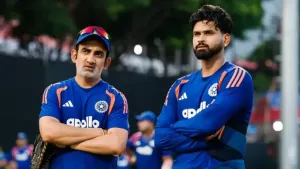
Gautam Gambhir is worried, and understandably so. With the 2027 ODI World Cup in South Africa firmly in the team's sights, India's inability to cope with seamer-friendly, bouncy conditions is becoming an increasingly difficult problem to ignore.
Being bowled out for 89 against New Zealand in the fourth ODI was bad enough. But Gambhir 's concerns stretch beyond Friday's humiliation. India had also slipped to 111 for 7 in the second ODI while chasing a modest 135, eventually scraping home through the DLS method. Two batting collapses in conditions that offer a glimpse of what could await them in South Africa should set alarm bells ringing.
"There's no benefit to sweeping it under the carpet. It isn't just this match. Even in the previous match, we were seven down for 111 or 112. Today we lost, so we are talking about it," the India head coach said at the post-match press conference. "It's concerning because yes, there is some help here for the bowlers, so we have to be not only mentally but from the skill point of view we need to be ready as well. You aren't going to score 70-80 in the first 10 overs in these conditions. If you're 35-40 for no loss, that is also good enough. In India, the easiest time for batting is the first 10-15 overs. Here it's probably the hardest time. This is the difference in these conditions, and with the amount of experience we have, hopefully we can adapt in the last game."
The India coach was particularly concerned about how quickly his team folded, rather than merely the final score. "You are always concerned when you get bundled out for 90-odd, why won't I be concerned? These are conditions which are going to be closest to what we might get during the World Cup," Gambhir said. "For me, the bigger concern is not the runs, it's how quickly we got bundled out, in around 26 or 27 overs. Hopefully, we can try and rectify that as soon as possible."
The wobble-seam ball was a key weapon for wrecker-in-chief Matt Henry , but Gambhir was reluctant to make the wobble-seam delivery the centre of discussion and pinned the blame squarely on indecisive Indian footwork.
"Honestly, I don't go into this much technicality, wobble seam and all that. Ultimately, it is the job of the batsman to negate the movement whether it is the upright seam, wobble seam or scrambled seam," he said. "I thought more than the wobble seam, it's the areas that have probably created a problem for us. It was that length where you couldn't go forward, you couldn't go back. It was that half-half length. We had to be more committed towards it rather than getting stuck on the crease."
The selection of Kuldeep Yadav ahead of Mohammed Siraj also raised eyebrows. Kuldeep endured a difficult outing, conceding 73 runs in eight wicketless overs. Gambhir defended the decision. "We thought that a wrist spinner would be more useful, as simple as it can get. In these conditions, especially on a bigger ground, if we can have a wrist spinner in the middle overs to try and take wickets, we thought that was an attacking option. Whatever we felt was the right combination, we went ahead with that."
Kuldeep's lack of rhythm was another talking point, but Gambhir was not inclined to offer excuses on the basis of limited opportunities.
"Game time will always be limited as a spinner when you travel overseas. But whatever opportunities you get, you try and make the most of it. It's not that he hasn't got enough game time. He played three ODIs against West Indies at home in Oct. So, this debate about less game time, getting into rhythm doesn't hold for me," Gambhir said. "I think when you are playing international cricket, you should try and be in rhythm most of the time. And whatever opportunities you get, you should try and make the most of it."
Related News




Latest Newsmore

Virat Kohli Matches Sachin Tendulkar In ODIs, But For An Embarrassing Record
13-Nov-2026 • Suyash Sahay

New Zealand Thrash India By 244 Runs! Matt Henry Destroys Batting Line-Up In 4th ODI
13-Nov-2026 • Prateek Thakur

Virat Kohli plays peacemaker after Gurnoor Brar's animated send-off to Seifert, video goes viral - Watch
13-Nov-2026 • toi

'2019 WC SF Flashbacks': Fans React As Matt Henry Rattles Virat Kohli, Rohit Sharma & Shreyas Iyer
13-Nov-2026 • Suyash Sahay

KL Rahul vs Rishabh Pant: Who Will Replace Axar Patel As DC Captain
13-Nov-2026 • Prateek Thakur