
Rohit goes from super to subdued in New Zealand
Karthik Krishnaswamy
cricinfo|18-11-2026
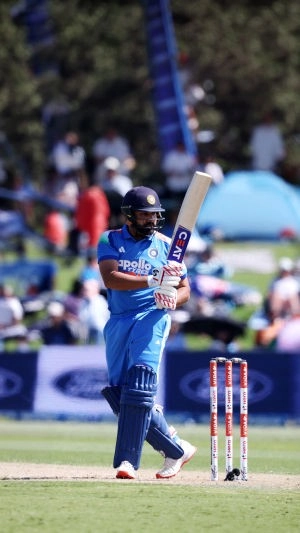
Thirty runs in four innings at an average of 7.5. Those are the numbers from Rohit Sharma's last tour of New Zealand. Only once before has he played that many innings in an ODI series and averaged less.
That series was 14 years ago in Sri Lanka back when the best years of his career were still ahead of him. On Sunday, when he played his final ball of this New Zealand tour, flicking too early at Matthew Fisher and popping a catch to midwicket, Rohit was 39 years and 199 days old. By the time India play their opening game of next year's World Cup against Australia in Cape Town, he'll be 40 years and 180 days old.
If he's playing in that tournament, he will have spent more than two years as a one-format international cricketer.
If. That felt like a big if five months ago, when India's selectors told Rohit they were planning to move on from him. It felt like a smaller if when he scored 138 in his very next innings, at Lord's. And he filled his boots in India's next ODI series, reeling off scores of 32, 101 and 92 against West Indies.
One bad series shouldn't take away from all that , particularly a bad series on the green, seaming, bouncy and often two-paced pitches of an unseasonably wet early summer. On the surface, Rohit's overall record over the last year-and-a-bit is unimpeachable: since the end of last year's Champions Trophy, he has 982 runs at an average of 46.76 and a strike rate of 98.89.
On the surface.
You don't have to dig too deep to see signs of concern. Take, for instance, the context of how his top-order colleagues have fared. The other two members of India's first-choice top three, Shubman Gill and Virat Kohli, average 75.00 and 63.37 respectively, and have struck at 112.84 and 114.18. This New Zealand tour apart, India have played the bulk of their ODIs on belters.
It wouldn't be a worry if Rohit simply averaged less than his top-order colleagues. It's the fact that he's also been scoring at a slower tempo, particularly because this is a batter who had previously led the way globally as an unstoppable first-powerplay force.
From the start of the 2023 World Cup to the end of the 2025 Champions Trophy, Rohit was the world's fastest-scoring batter in the first 10 overs of ODIs (minimum 200 balls faced), striking at 133.68 in this phase and hitting a six roughly every 14 balls. Incredibly, he also averaged 62.5 in this phase, so he wasn't just going after the bowling at every opportunity; he was doing it with a high degree of certainty.
Since his match-winning 76 in the Champions Trophy final, Rohit has been a far more subdued starter. Across 22 ODI innings, he's struck at 86.25 in the first ten overs and hit a six every 30 balls. He still has a more than decent first-powerplay average of 48.11, but these are the numbers of a pretty good ODI opener, not the elite one he has been for so much of his career.
And the issue extends to the underlying numbers. It's not as if Rohit has gone back to his earlier mode as an ODI operator: cautious starts and ominously gathering momentum. It's that he seems to have become a less certain starter on the whole. It isn't just his powerplay strike rate that's dropped since the Champions Trophy, but his control percentage in this phase too, from 78.79 in that World Cup-to-Champions Trophy mini-cycle to 75.30. And when he's been in control, he's gone at just a run a ball, compared to 152.26 in the earlier period.
Related News
Latest Newsmore
MS Dhoni IPL Retirement: End of Mahi's era, Thala will now be seen in this new role after retiring from IPL; Chennai Super Kings made a big announcement
17-Nov-2026 • Sandy Verma
IPL 2027 Retention List LIVE Updates: Dhoni retires to become CSK mentor; Shami, Curran part of trade on deadline day
17-Nov-2026 • Samira Vishwas
ICC Punishes India Fast Bowler For Fiery Send-Off To New Zealand Opener
17-Nov-2026 • Suyash Sahay

'There is no CSK without MS Dhoni': N Srinivasan's emotional message, calls signing Thala in 2008 his 'best decision'
17-Nov-2026 • toi
MS Dhoni at CSK: 5 titles, 10 finals and a new role ahead of IPL 2027
17-Nov-2026 • toi