CricketnMore
newspoint|16-04-2026
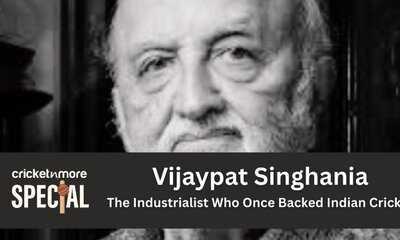
Recently Ex-Raymond chairman Vijaypat Singhania died at 87 in Mumbai. The news of the death of the Padma Bhushan awardee was mostly covered on the business page of the newspapers as he is widely remembered as a visionary industrialist. In fact, he had an inspiring personality and had an interest in aviation and public life also. Surprisingly, neither cricketers nor the BCCI remembered him for his association, probably because today his contribution and support to Indian cricket appears to be insignificant, but at one time, he was one of the corporates who cared for cricket.
There was a time when Vizzy, former India captain and Maharaja, brought international cricket to Kanpur, he got the full support of Singhanias JK Group. Their HO was at the Kamla Tower in Kanpur and for many years Indian teams used to stay at their Guest House in Kamla Tower while tourists were staying at different hotels. This GH was basically for the staff and the outside business people, visiting Co. HO and lacked decent staying facilities. There are various stories of the team staying there.
During the visit of Jock Livingstons Commonwealth XI to India in 1949-50, the 4th unofficial Test was played at Kanpur, from January 14ndash;18, 1950 and Vijay Hazare#39;s India XI, with all-star cricketers, stayed at Kamla Tower. The cricket historian Edward Docker, in his wonderful compilation lsquo;History of Indian Cricket reported, lsquo;Vijay Merchant (former India cricketer and Manager of this India XI) had the least hesitation in pointing out to the president (of UP Cricket Association and former India captain Vizzy) the very inferior accommodation provided for the Indian team at Kanpur. His men had to sleep at Kamla Retreat with poor food and an insufficient number of blankets. JK Group never charged for the arrangements and the local state cricket Association was saving the money.
Vijaypat Singhanias most significant contribution was the formation of a star-studded JK Sports cricket team, under Nawab of Pataudi (at the far end of his cricket career) in the 70s. During those days, Indian cricket badly needed corporate support as cricketers, not earning much by playing, were looking for the jobs. The patronage came through Railways, State Bank of India, Tatas, ACC, Mafatlal, Nirlon, RBI, Mahindra and Burmah-Shell etc. as they provided the jobs and formed their own cricket teams.
JK Chemicals joined this race and formed JK Sports, but with a difference. They just encouraged cricketers to play as a team, without giving them jobs. The cricketers were paid participation fees. Nawab Pataudi was entrusted not only to lead the side, but establish JK Sports as a formidable side. Richard Cashman, in one of the finest books on Indian cricket, lsquo;Patrons, Players and the Crowd: The Phenomenon of Indian Cricket, discussed the rise and fall of this side. Pataudi engaged the Amaranth brothers, Salim Durrani, Karsan Ghavri and many other talented youngsters such as Rajinder Singh Hans. They won the Sheesh Mahal Trophy in Lucknow consecutively for three years and some other events.
In a few years, this team lost its steam, although Vijaypat Singhania ensured that cricketers were well paid and provided the best facilities. Something was wrong with planning and structure. The Co. HO was at Thane, near Mumbai, and the team was provided accommodation there. However, they had to go to CCI (some 25 km away) for practice, without proper traveling arrangements and some precious hours were wasted daily on commuting.
Pataudi, who was the mastermind behind the formation of the team, was not living in Mumbai and most of the time he was absent when the team or management needed him. The Co. policy of not giving jobs to cricketers also backfired, as the cricketers, although they played for them, were more loyal to their employers. The JK sports team was regularly missing one or two important players, for the matches, disturbing the balance of the team. It became a regular feature that, instead of playing with their best side, the management was running to assemble 11 players to form an XI. The side had the potential, but mostly they were playing without their best side.
If Vijaypat Singhania was at the stadium for the match and found star players missing, without any permission/information, he used to get annoyed. This was, however, a regular feature, and slowly he also lost interest in the side. A senior journalist, Raju Bhartan (of Illustrated Weekly of India fame) wrote a detailed article about this JK side and mentioned one particular incident.
It was a custom that at the end of each match, a senior player of the side would visit the Co. office, collect the remuneration cheques and distribute them among the players. After one match in Mumbai, none of the players came to collect the cheques and, instead, a local boy (not associated with the team in any way) was sent to the Co. office to collect the cheques. When Vijaypat Singhania came to know about it, he immediately abandoned the cricket team. This was in 1977.
Also Read: Live Cricket ScoreWho remembers those days?

Told Banton And Luke That Ashish Nehra Is Unique, Take Him For What He Is: Buttler

IPL 2026: MI Name Krish Bhagat As Replacement For Injured Atharva Ankolekar
IPL 2026: 3 players who can replace Khaleel Ahmed in Chennai Super Kings squad
IPL 2026: CSK Fast Bowler Khaleel Ahmed Ruled Out Due To Quadricep Injury