

Samira Vishwas
Tezzbuzz|21-04-2026
A winner on the Asian and Japan golf tour, Ajeetesh Sandhu explains how cricketers easily pivot to golf due to the inherent similarities.
Arc of cricketers’ swing resembles golfers
The first thing I think of when I watch Abhishek Sharma hold his finish after a six isn’t cricket. It’s golf. For a brief moment, the swing, the balance, even the rhythm feel like they belong on a fairway rather than a cricket ground.
I wouldn’t go so far as to say the two are identical, but there are passages of play where the overlap is impossible to ignore.
Every time a batsman strikes the ball cleanly and lets the bat flow through the line, there’s a certain freewheeling quality through impact. That’s what catches my eye. The bat, much like a golf club, is released at speed but without tension. In those moments, the connection between the two sports feels very real.
Advantages for cricketers
For me, though, the similarities aren’t just visual. They’re deeply rooted in how the body works. In golf, once we complete our backswing, the first move is initiated by the hips. That’s where the power comes from. The hips lead, the shoulders follow, and then the arms and hands come through, delivering the club into the ball. It’s a sequence where each part of the body plays its role at precisely the right time.
Cricket, especially when you look at lofted shots or clean hits down the ground, follows a similar pattern.
Habits that don’t translate smoothly
When cricketers pick up a golf club, you begin to notice the different habits. Cricketers, with their incredible hand-eye coordination, make contact with the ball quite naturally. But there are also tendencies that don’t translate as smoothly.
Challenges for a cricketer playing golf
The most noticeable challenge is how tough it is for them to release the club. A cricket bat is heavier, more solid in the hands, while a golf club feels comparatively light.
For someone who has spent years swinging a bat, the club can feel almost too flimsy. And because of that, there’s a tendency to hold on to it through impact rather than letting it release. What that does is shape the swing in a very particular way. It starts to resemble a cover drive. The result is that the ball often drifts to the right, especially for a right-handed golfer.Starting with heavier club
If I were to suggest a way to bridge that gap, I’d actually start with something quite simple: the weight of the club.
Giving them a slightly heavier club in the beginning might help replicate the feel of a cricket bat. It allows them to trust the motion a bit more, to understand how the club should move through impact without feeling like they’re losing control of it.Timing, the common factor in both
What’s interesting is that the exchange doesn’t just go one way. There are elements of golf that can just as easily feed back into cricket. Timing, for instance, is everything in golf. So, the entire swing becomes a process of building energy gradually and releasing it at exactly the right moment.
Impact: The key peak point
It’s not about being completely still, but about coiling and uncoiling. There’s a long backswing, a clear change of direction, and then an acceleration through the ball. Everything peaks at impact. Until that moment, you’re simply loading energy. Waiting, loading, releasing.
That sense of timing can be invaluable in cricket as well. If a batsman is able to align their movement so that everything comes together at the point of contact, it can make a significant difference. At the highest level, even the smallest improvement in timing can elevate performance.
Lefties having more rhythm
From what I’ve seen, I feel Abhishek Sharma would have a very good golf swing. I think left-handers, anyway, have a lot of fluidity and, frankly, I’ve always had a big bias towards left-handers. I feel like they’ve got a lot of rhythm and are more free-flowing, whereas the right-handed golfers and cricketers can get a little bit more technical. I like the flow of Abhishek’s bat. It is very uniform, and I think that’s why he also hits the ball so well. It’s very easy for that to get transferred over, even in golf. Sometimes, all it takes is that one image, like Abhishek holding his finish after a six, to see it.


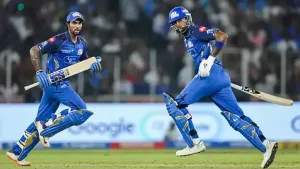
IPL 2026, GT vs MI: 3 big reasons for Gujarat Titans’ defeat

Tilak Varma’s century inspires Mumbai Indians to 99-run victory over Gujarat Titans in IPL 2026

3 Mistakes That Mumbai Indians Rectified To Win The GT vs MI IPL 2026 Contest

Ashwani Kumar Shines with Four-Wicket Haul in Mumbai Indians’ 99-Run Win Against Gujarat