

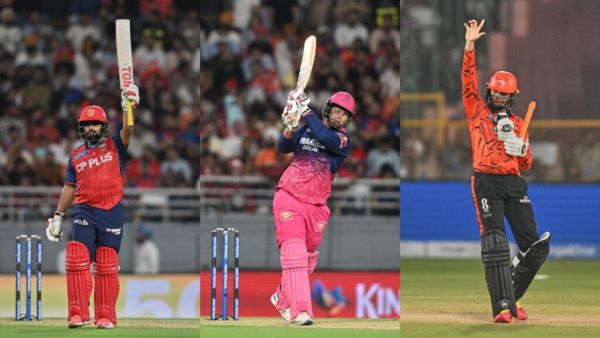
Marcus Stoinis’ stunning 22-ball 62 (not out) went in vain on Tuesday night as Punjab Kings failed to defend a 222-run total against Rajasthan Royals at the Maharaja Yadavindra Singh International Stadium.
Stoinis’ knock came at the back end of the innings and, although it lifted the home side to a competitive total, it wasn’t enough to shut the Royals out as they chased it down with four balls to spare and six wickets in hand.
A couple of days earlier, PBKS had done something similar, registering a record T20 chase of 265 against Delhi Capitals.
A common factor in this IPL season’s wins has been PowerPlay performances. The Royals scored 84 for one in the first overs in reply to the Kings’ 65 for one. Similarly, DC had managed 68 for one against PBKS, which finished the fielding restrictions after scoring 116 runs without loss.
PowerPlay overs have decided 73.68 per cent of matches this season.
“Over the years, teams have realised how important the PowerPlay is: only two fielders outside, six overs to maximise. So naturally, there’s more focus on that phase now,” RR fast bowler Sandeep Sharma said.
There has been a steady rise in batters targeting the boundaries in the PowerPlay, with run rates climbing from 7.7 in the inaugural season to 8.42 in 2018, and now 9.9 this season.
“What we’re seeing is a trend across the tournament – how dominant teams are in the first six overs. It’s very hard to stop sides now with the way they’re playing in the PowerPlay. You’ve also got the replacement player rule, which allows you to stack your batting and go even harder,” PBKS assistant coach Brad Haddin said.
A look at the points table also reflects which teams have embraced this approach of setting up, or even finishing, games early. Punjab, Royal Challengers Bengaluru, Sunrisers Hyderabad, and Rajasthan, the current top four, also boast the best returns from their top three batters, especially the openers.
For PBKS, Prabhsimran Singh and Priyansh Arya have scored at a strike rate of 205.55, followed by Royals openers Yashasvi Jaiswal and Vaibhav Sooryavanshi at 195.56. SRH’s Abhishek Sharma and Travis Head are at 183.17, while RCB’s Virat Kohli and Phil Salt/Jacob Bethell have struck at 164.42.
Winning the PowerPlay isn’t a guarantee, but it gives the batting side a significant advantage for the rest of the innings. DC openers, for instance, have a higher strike rate (172.35) than RCB’s. But with the rest of Bengaluru’s lineup sustaining the pressure, it has translated into results, while the Capitals remain in the bottom half.
Is the finisher’s role going extinct?
The relentless pressure from ball one has made 200-plus totals par, even if they don’t guarantee wins. Openers are expected to score at a minimum of 10 an over, and the rest of the batting order must maintain a similar tempo.
Teams are no longer building towards a late surge. The first six overs are now played with almost the same boundary-hitting intensity (26.11%) as the final four overs (24.12%).
“I don’t think there is a thing called finishers anymore. It’s right from ball one – everyone is going at a rate of knots,” Chennai Super Kings coach Stephen Fleming had said earlier this season. “It’s not a build-up to the 16th over and then going harder. Everyone is going hard from ball one. Run rates of 10, 11, 12 throughout are expected. You’re not really getting the big peaks at the end, it’s just a more aggressive approach to get 240.”
Table-topper Punjab has been the most successful in executing this approach. While the top three score at over 12 an over, numbers four and five go at 11.1, and the lower middle order (6-8) at 10.81.
“If you look at the way we’ve played, our top order has been super dynamic. They’ve set up games and created opportunities,” Haddin said.
“But what the rest have done is contribute in roles that win matches. It might not be a 70 or 80 – it could be 15 off six balls to give us momentum. At the moment, they’re doing everything the game requires.”
Sandeep, however, believes finishers remain vital, especially over a long tournament.
“I don’t think the importance of finishers has reduced at all. Teams with strong finishers still have a great chance. If you look at the past, Chennai had Mahi bhai (MS Dhoni), Mumbai had Hardik Pandya and Kieron Pollard, and KKR had Andre Russell. Teams with strong players at 5, 6, and 7 tend to go far. That’s where the bulk of pressure lies. The top three don’t carry as much pressure – if they get out playing positively, it’s accepted. But 5-6-7 is a crucial phase,” he said.
This season has still produced instances of lower-order influence, such as Rinku Singh’s effort in Kolkata Knight Riders’ Super Over win against Lucknow Super Giants, but those moments are becoming rarer in a league where the PowerPlay is fast becoming the new death overs, and openers the new finishers.
Published on Apr 29, 2026