
Sandy Verma
Tezzbuzz|27-05-2026
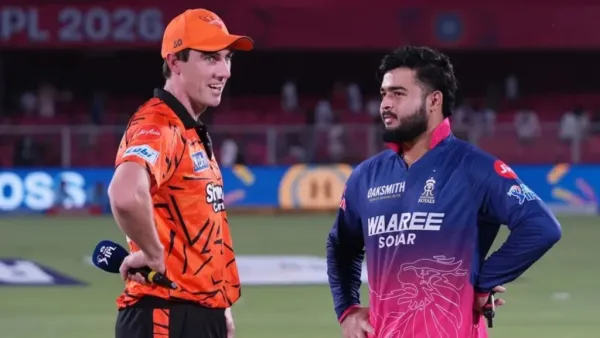
The Eliminator is the match everyone gets wrong in their playoff previews. There is a tendency to treat it as a lesser fixture, the match for teams that could not make the top two. This framing misses the point entirely. The Eliminator is a knockout game with no second chance, and it features two of the most explosively batting-heavy sides in IPL 2026.
Sunrisers Hyderabad versus Rajasthan Royals at the Maharaja Yadavindra Singh International Cricket Stadium in Mullanpur on Wednesday evening is not a consolation. It is a game where one extraordinary batting lineup ends another extraordinary batting lineup’s season. The losing dressing room empties permanently.
SRH arrive having won both their league-stage meetings with RR this season, a record that matters as a confidence marker but is rendered somewhat academic by the reality that playoff cricket operates on its own logic.
Rajasthan qualified dramatically, beating Mumbai Indians at the Wankhede in their final league game. SRH qualified with a fifty-five run hammering of RCB that felt comprehensive until you remember they still finished third on net run rate despite having the same wins as the top two. Both teams know they should be doing more. Wednesday is where that frustration gets resolved.
SRH vs RR Eliminator: The opening act that will set the tone for everything
IPL 2026 has not produced a more individually exciting batting contest than Vaibhav Sooryavanshi versus whoever is trying to stop him. The fifteen-year-old arrives at Mullanpur with 579 runs at a strike rate approaching 240, numbers that belong in a different sport, and he will face an SRH attack that has been studying the limited evidence of what actually works against him.
Mohsin Khan is the most relevant data point. The left-arm seamer’s angle cramped Sooryavanshi by bringing the ball in, restricting his favorite legside options. Pat Cummins and Eshan Malingaboth tall, both comfortable bowling into the pitch, offer SRH a similar but distinct threat the short ball angled across the right-hander, inviting the pull or the hook, testing whether Sooryavanshi can play the upper-cut or ramp under pressure. A
cross this entire season, he has not shown great propensity for either. The Mullanpur square boundaries are big enough that mistimed attempts in those regions go to fielders rather than over the rope.
Yashasvi Jaiswal alongside him gives RR the most aggressive left-handed opening combination in the competition. The approach that worked against Jaiswal. bowling at him from straight angles, which is how Malinga got him in Jaipur and Sakib Hussain dismissed him in Hyderabad, gives SRH a consistent plan rather than a guessing game.
Two bowlers who have already had success against both openers, on a surface where big square boundaries assist that style of attack. The powerplay between Sooryavanshi, Jaiswal, Abhishek Sharma, and Travis Head on the other side is the specific passage of play that produces the largest swings in any match these teams play. Get through the first six overs with two or three of those four dismissed cheaply and the game changes shape immediately.
SRH vs RR Eliminator: Jofra Archer questions that Rajasthan cannot avoid
Jofra Archer is RR’s most potent bowling weapon and the one bowler who has genuinely tested SRH’s explosive openers. He has taken four wickets across sixty-eight balls against Head and Abhishek Sharma combined this season, including Abhishek in the first league meeting and Head in the reverse fixture which is the kind of record that tells you the match-up produces results even if the boundary count is also high.
Approach that works is specifically Archer-shaped: over the wicket, pitching in the blind spot just outside leg on a good length or fractionally short, and then getting his natural movement toward off. This is not a tactical reinvention. It is exactly what Archer bowls naturally, which means the advice here is essentially to be Jofra Archer as effectively as possible, which he has been doing well all season.
Concern for RR is what happens if Archer’s first over does not yield a wicket. SRH’s openers are specifically good at seeing off a new bowler’s opening spell and recalibrating, Pat Cummins has spoken about the team’s tactical approach of absorbing the first over of a genuine threat bowler before attacking.
If Archer bowls a tight but wicketless first over, RR might consider Donovan Ferreira’s medium pace as an alternative while Archer resets a small tactical flexibility that could prevent the run rate from climbing during Archer’s least effective phase.
SRH vs RR Eliminator: Pat Cummins in the middle overs and why his bowling is being underrated
Pat Cummins’ return from injury transformed SRH’s season. Five wins from seven since he came back. An economy rate of 5.66 in overs seven to fifteen, the best of any bowler across the tournament with at least fifty balls bowled in that phase. He bowled Riyan Parag out with an inch-perfect yorker in his very first game back in Jaipur, on a flat surface where two hundred and twenty-eight runs was not enough to win.
His method, relentlessly bowling into the pitch, mixing hard lengths with pace variations that are almost invisible at first glance, is the specific style that works on the Mullanpur surface where the big square boundaries reward bowlers who keep the ball off the straight boundary.
RR’s middle order, Dhruv Jurel, Riyan Parag, Donovan Ferreira, Shimron Hetmyer, represents a significant vulnerability to the exact approach Cummins, Sakib Hussain, and Eshan Malinga will bring. Slower cutters are effective against most of them.
Jurel, Ferreira, Hetmyer and Dasun Shanaka have all shown susceptibility to the ball gripping and stopping off the surface. The one exception is Parag himself, who has developed a specific skill for picking the slower ball and punishing it.
In the last two IPL seasons, Parag has faced twenty-nine balls of left-arm wrist spin for thirty-nine runs and one dismissal, which points towards Shivang Kumar as a potentially decisive middle-overs option if SRH can engineer a situation where Parag is forced to attack the left-arm wrist spinner rather than choose his moment.
SRH vs RR Eliminator: Klaasen and the left-hander problem that RR must solve
Heinrich Klaasen has six hundred-plus runs this season batting at number four, the first batsman from that position or lower to achieve this in a single T20 tournament. His evolution this season is the most interesting individual story in SRH’s campaign.
He is no longer purely the six-hitting finisher. He can absorb pressure, play out a difficult spell, and then shift into destruction mode. Against spin, he has been exceptional almost universally, virtually every spinner in the competition has been expensive against him.
RR’s best option here is Yash Raj Punja, eight wickets and an economy of 8.79, the most effective RR spinner this season, and a bowler who has removed three left-handed batters at 8.1 per over. Against Klaasen specifically, Punja will need to adapt. His default approach of pushing batters back onto the back foot will not work against someone who welcomes the invitation to hit over the leg side.
Against Klaasen, Punja needs to be braver, tossing it up, inviting the drive, using the Mullanpur surface to generate turn. It is a significant ask of a young bowler, but the tactical situation points towards him as the most appropriate weapon for this specific match-up.
SRH have three left-handers in their top three, Abhishek, Head, and Kishan, which has historically prevented Ravindra Jadeja from being used freely in previous meetings between these teams. Punja carries that left-arm spin burden on Wednesday and how he handles it across the evening could be worth watching.
The team that wins the first six overs wins the match.






'He is under observation' - Rajat Patidar provides injury update on Phil Salt ahead of Qualifier 1 vs GT

IPL 2026: Arshdeep Singh removes more than 200 Instagram posts amid rumours of rift with Punjab Kings
RCB vs GT, IPL 2026 Qualifier 1: Bhuvneshwar meets Rabada, Kohli meets Gill and Dharamshala decides who goes directly to the final
IPL 2026: If this happens, RCB will reach the final without playing Qualifier-1.