
Samira Vishwas
Tezzbuzz|10-07-2026
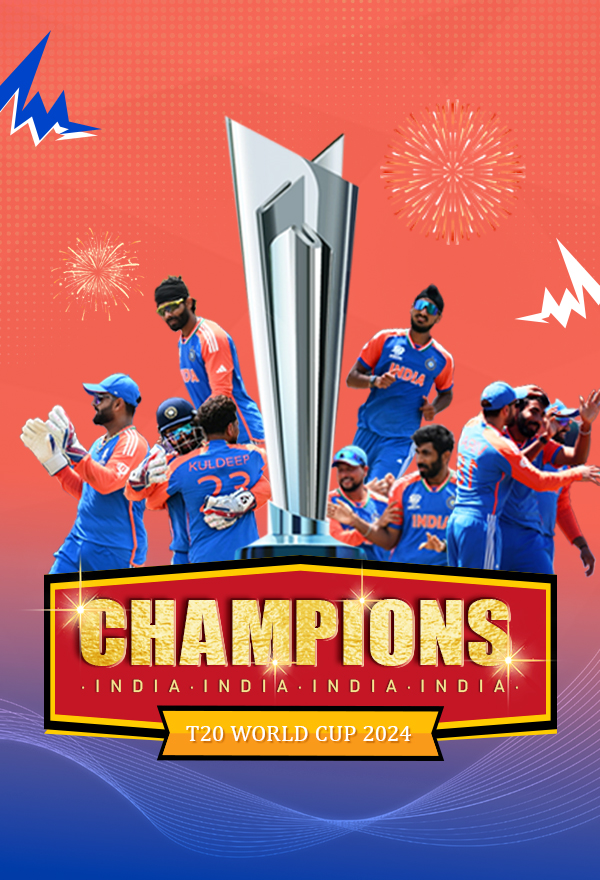
Less than four months after lifting the T20 World Cup, India have found themselves trapped in a sequence that would have appeared almost unimaginable on the night of their triumph in Ahmedabad.
Ireland first defeated the world champions in both matches of their T20I series, recording their maiden international victory over India before completing a historic 2-0 sweep. England have since inflicted further damage. India were dismissed for 76 at Trent Bridge and beaten by 125 runs – their heaviest T20I defeat – before a nine-wicket demolition in Bristol secured England’s first bilateral T20I series victory over them.
India have now lost five consecutive completed T20Is.These results are extraordinary not simply because India have lost, but because of what they have become accustomed to winning. Gautam Gambhir’s side followed the unbeaten Champions Trophy triumph of 2025 with an undefeated Asia Cup campaign and then retained the T20 World Cup in 2026, crushing New Zealand by 96 runs in the final. Their only defeat across those three tournament campaigns came against South Africa during the T20 World Cup.
It has created perhaps the strangest period Indian cricket has known: a team capable of looking historically dysfunctional in bilateral competition and historically dominant when a trophy is placed before it.
India have lived through contradictions before
The closest parallel lies between 1983 and 1985.
India stunned West Indies to win the 1983 World Cup, claimed the inaugural Asia Cup the following year and then produced a commanding unbeaten campaign at the 1985 World Championship of Cricket.
Yet the bilateral results surrounding those victories were brutal. West Indies toured India after the World Cup and won the Test series 3-0 and the ODI series 5-0. England subsequently won the 1984-85 Test series 2-1 and the ODI contest 4-1.There is an obvious resemblance. India were collecting trophies while being comprehensively defeated in supposedly more routine assignments.
However, that team occupied a very different place in cricket’s hierarchy.
The 1983 victory was a sporting revolution precisely because India were not expected to win. They were still discovering their strength in limited-overs cricket, while West Indies remained the most formidable team in the world. Their bilateral defeats were not evidence of a dominant system collapsing; they reflected the uneven growth of an emerging force.The second major parallel came during MS Dhoni’s reign.
India won the 2011 World Cup but were then whitewashed 4-0 in successive Test series in England and Australia. England also came to India in late 2012 and won the Test series 2-1.
Within months, however, India whitewashed Australia 4-0 at home and travelled to England to win the 2013 Champions Trophy without losing a match.That period contained dramatic extremes, but the divide was broadly explicable. India’s ageing Test side was deteriorating overseas, while its limited-overs unit remained young, athletic and tactically advanced. The contradiction was principally between formats and conditions.
There have been shorter bursts of chaos, too. In 2007, India suffered a disastrous first-round elimination from the ODI World Cup before winning the inaugural T20 World Cup only months later. Yet that was a sudden rebirth under a new captain and with a radically different squad – not a prolonged pattern of tournament supremacy coexisting with bilateral disorder.
Why the Gambhir era feels different
The present fluctuation is not neatly divided by format, conditions or generation. It is increasingly divided by occasion.
India have suffered historic damage in Tests, including New Zealand’s 3-0 home whitewash and South Africa’s subsequent series victory. They have lost an ODI series in Sri Lanka, where they had not been beaten in a bilateral contest for 27 years, and New Zealand secured their first ODI series victory on Indian soil in January 2026. Now the reigning T20 world champions have been swept by Ireland and overwhelmed by England.
This is therefore not an excellent white-ball team compensating for a failing Test side. India can be superb and shambolic within the same format. The distinguishing factor appears to be whether the matches form part of a championship campaign or a bilateral series.
During tournaments, experimentation ends. Senior players return, roles become clearer, and India identify a combination they are prepared to protect. The emotional stakes produce sharper cricket. Every match carries a visible consequence, every weakness can end the campaign, and the team’s enormous depth allows it to survive individual failures.
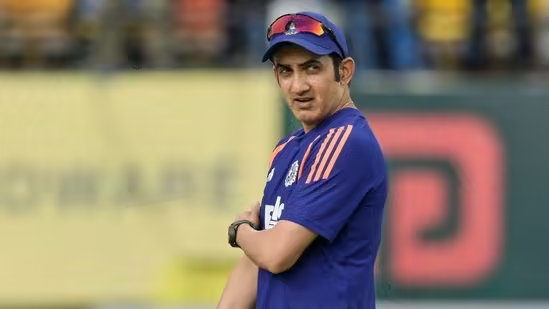
Outside tournaments, the national side often resembles a laboratory. Captains change, established performers are rested or discarded, young players are accelerated, batting orders are adjusted, and aggressive ideas are tested without always being modified for conditions. The team that lost in Ireland and England was not identical to the one that lifted the World Cup, but that distinction is part of the story rather than a complete defence. The head coach is responsible for the broader ecosystem, not merely the strongest XI assembled for finals.
Gambhir’s methods may also create naturally volatile results. His white-ball vision values intent, depth and sustained aggression. At its best, that approach overwhelms opponents and makes India exceptionally difficult to contain over a tournament. At its worst, especially with an inexperienced or unsettled side, aggression becomes fragility. Once early wickets fall, there may be no alternative rhythm available.
Everything works while the trophies keep coming
India’s previous contradictory eras could usually be understood through format, geography or transition. This one is more peculiar. The same system appears capable of producing its greatest clarity under tournament pressure and its deepest confusion outside it.
That does not necessarily make the Gambhir era unsuccessful. International cricket has increasingly become defined by global tournaments, and India spent years being judged harshly for dominating bilateral series without converting that superiority into trophies. Gambhir’s side has decisively reversed the equation.
For now, the bargain remains overwhelmingly favourable. Supporters will tolerate lost series, experiments and even occasional humiliation if India continue lifting the trophies that once repeatedly escaped them.
Everything is good as long as those trophies keep coming. But the first time India enter a major tournament and return empty-handed, all the bilateral wreckage currently dismissed as preparation will suddenly look less like experimentation – and much more like warning.






2026 ENG vs IND 4th T20I Playing 11: Washington and Prasidh Named in India’s Lineup

Shreyas Iyer made a big record in winning the toss, Rohit Sharma left behind

The Story of Shapoor's Heroism, the Schoolgirls, and the Echoes of Victory

IND vs ENG 4th T20I: Toss Result & Complete Playing XIs