
Sandy Verma
Tezzbuzz|28-08-2026
For more than a decade, Sri Lanka was a happy hunting ground for Team India. A domain in which they notched out six consecutive Test victories, showing off their ruthlessness to neighbors nearby. But history has a strange way of coming full circle. The two results which bookend this golden era of Indian dominance, a shocking collapse in Galle in 2015 and a frustrating stalemate in Colombo in 2026, are eerily similar.
Though separated by a decade, a changed guard, and different captains, the two matches have the same story. An imperious Indian side which took control of proceedings early on, only to watch a plucky Sri Lanka claw their way back to victory or a draw.
In both cases, India still managed to clinch the series, but these matches were masterclasses in how to lose control of a game.Here is how Sri Lanka scripted two remarkably similar escapes against India in the odds
1. The Second-Innings Resurrection
Compare and Contrast Galle 2015 Test Final & Colombo 2026 Match
The biggest similarity between Galle 2015 and Colombo 2026 was Sri Lanka's determination to fight despite the huge deficit in the first innings.
At Galle, they made a 192-run deficit after scoring 375, and when they were in a bad position of 5 for 3 in the second innings and an innings defeat was inevitable, the talisman Dinesh Chandimal responded in stunning fashion. He played an unbeaten 162 off 169 balls to set a challenging 176-run target for India, which triggered an infamous Indian collapse.
Forward to the present day, where India held a massive 213-run lead in the 2026 Test match at the Sinhalese Sports Club (SSC) and enforced the follow-on.
Sri Lanka launched yet another astonishing fightback with the newcomer Pasindu Sooriyabandara notching up his second half-century of the match while Sonal Dinusha added a historic third century of the series. Their lower order showed gritty resistance to the Indian bowlers on the fifth day to bat the tourists out of time to force a draw.2. Opening Order Misery
Although Sri Lanka's middle and lower order showed grit, the opening batsmen had similar issues in both matches, giving India the advantage.
In the 2015 Galle Test match, the opening pair Dimuth Karunaratne and Kaushal Silva was completely dismantled by the Indian new-ball bowlers, scoring just 14 runs between them in both innings (including a double duck in the second innings).
Eleven years later at Colombo, the opening-order misfortune continued when Pathum Nissanka was injured, and Nishan Madushka failed to hold his place in the team. The opening batsmen Kamil Mishara wasted good starts in both innings, and Lahiru Udara was dismissed cheaply by the Indian seamers for 1 and 3. Sri Lanka's middle-order fighting men had to rebuild from the ruins in both Eras.
3. Twins Indian Centurions in vain
Both matches witnessed a batting display from India in the first innings with a pair of centuries that should have won the match.
In 2015, Shikhar Dhawan (134) and skipper Virat Kohli (103) accounted for nearly 2/3 of India's 375.
In 2026, history repeated itself when India posted a formidable 503 for 9, with Devdutt Padikkal continuing his red-hot form with a sublime 117 at number three while Dhruv Jurel silenced his critics with a gritty and long-awaited century after a nerve-wracking innings in the nineties.
However, in both the 2015 and 2026 Test matches, the twin hundreds in the first innings failed to break the spirit of Sri Lanka. India failed to replicate the total command of the game as they pondered how absolute control led to absolute frustration.



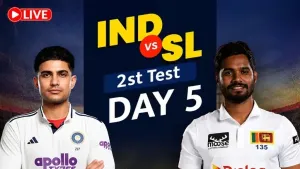
IND vs SL 2nd Test Day 5: India eyes clean sweep in Colombo Test, Sri Lanka has 4 wickets left

Two Cricket Legends' Sons Picked For India's U-19 Team Against Australia
Tim Seifert Ton, Chase Magic Help Saint Lucia Kings Survive Pollard Scare
8 batsmen could not even open the account, the team was limited to 35 runs, you will be confused after seeing the scorecard.